Living Neurons Are Computing in a Data Center. The Hard Part Is Proving They’re Efficient.

Executive Summary
"Learn how neuron-powered biological computing systems combine living human stem-cell-derived neurons with electronics, and why their potential energy advantage remains unproven."
The deployment of Singapore's first neuron-powered biological computing systems marks a historic shift in the evolution of digital infrastructure. In an era where artificial intelligence demands unprecedented levels of electricity, researchers and engineers are looking to biology for a solution. By combining living human stem-cell-derived neurons with traditional silicon hardware, this prototype aims to demonstrate how wetware, a term used for computational systems that integrate living biological tissue with electronics, can process information at a fraction of the energy required by conventional silicon chips.
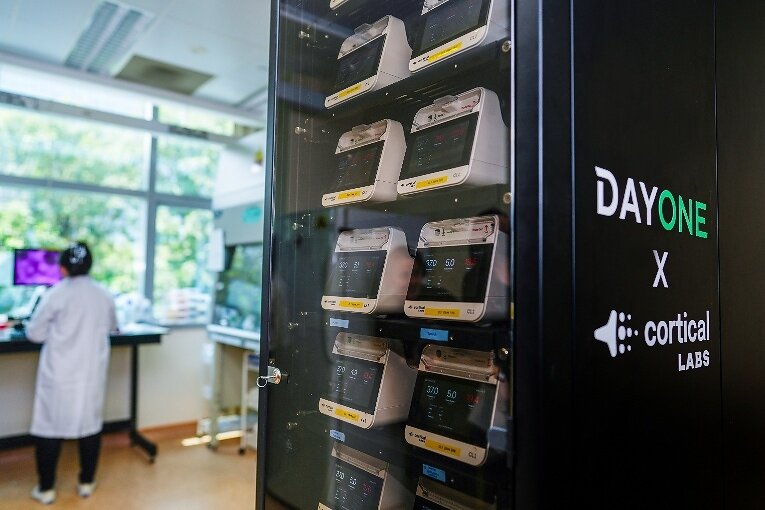
This initiative brings together the digital infrastructure platform DayOne, the Melbourne-based biological computing startup Cortical Labs, and the Yong Loo Lin School of Medicine at the National University of Singapore, commonly known as NUS Medicine. Together, these partners have built and activated a 20-unit server rack powered by human neurons grown in a laboratory. This installation, housed in a live research environment at NUS Medicine, represents the first independently operated, biologically integrated server rack in the world.
The Architecture of Neuron-Powered Biological Computing Systems
At the core of this system is the CL1 biological computing platform developed by Cortical Labs. According to a DayOne press release, the setup consists of 20 individual CL1 units integrated into a single server rack. Unlike traditional computers that rely solely on silicon transistors to process binary code, these units use living neurons to perform computational tasks.
The neurons used in the system are derived from stem cells, which are unspecialized human cells that possess the remarkable ability to develop into specific cell types. These cells are cultured and matured at the NUS Life Sciences Institute. Once developed into functional neural networks, they are integrated into the computing hardware. The biological processors are designed to interact with digital systems, allowing researchers to explore how biological neural networks learn, adapt, and process information in real time.
In simplified form, one processing cycle looks like this:
input → electrical stimulation → living neuronal network → electrical response → read back by the electronicsThis physical integration of living cells into hardware represents a significant step forward from theoretical research. As reported by BioSpectrum Asia, the milestone advances biological computing as an energy-efficient complement to traditional silicon-based infrastructure, opening up new possibilities for adaptive computing.
The Energy Equation: Biological Nodes vs. Silicon
The primary motivation for developing biological computing systems is energy efficiency. Conventional data centers consume massive amounts of electricity, and high-density artificial intelligence racks can easily exceed 100 kilowatts. This high power consumption contributes to a significant environmental footprint and places a heavy burden on local power grids.
In contrast, the electrical requirements of the biological prototype are remarkably low. Cortical Labs states that each CL1 unit operates at approximately 25 watts. A fully populated 20-unit rack draws between 800 and 1,000 watts. This means the entire biological rack in Singapore draws about as much electricity as a few standard desktop computers. On paper, the biological system has an extraordinarily low power requirement compared with high-density artificial intelligence infrastructure. But power consumption alone is not a measure of computational efficiency.
However, the low wattage of the biological processors does not represent the entire energy equation. To keep the living neurons viable, the system must run supporting hardware constantly. Each CL1 unit requires automated fluid pumps, gas mixing systems, temperature controllers, and filtration devices. These maintenance systems ensure the biological environment remains stable, allowing the cultured neurons to survive for up to six months. This continuous maintenance cycle is a unique operational requirement that silicon-based servers do not share.
Culturing Living Processors: The Biological Maintenance Cycle
Maintaining living human neurons inside a server rack requires a highly specialized environment. Unlike digital chips, which can be turned off or stored in varying temperatures, biological processors require constant biological support. The neurons must be supplied with nutrients, kept at precise temperatures, and protected from contamination.
This continuous care is managed by the automated systems built into each CL1 unit. The fluid pumps deliver a steady supply of nutrient-rich media to the cells, while the filtration systems remove metabolic waste products. The gas mixing and temperature control systems replicate the physiological conditions of the human body. If any of these systems fail, the biological processors will degrade, ending the computational capacity of the unit.
This biological maintenance cycle presents a novel challenge for data center operators. Traditional data centers focus on cooling, power distribution, and physical security. Introducing biological components means operators must now manage sterile fluids, gas supplies, and cellular life cycles. It shifts the role of the data center from a purely mechanical facility to a hybrid laboratory.
The Global Neuromorphic Landscape
The Singapore prototype is part of a broader global effort to replicate the processing efficiency of the human brain. Other organizations are pursuing similar goals using different methods. For example, the Swiss company FinalSpark operates a remote platform that utilizes 16 brain organoids, which are three-dimensional, simplified models of human organs grown in vitro. FinalSpark claims that these biological processors use up to a million times less energy than traditional digital silicon chips. This figure should not be read as meaning an organoid computer is a million times more efficient than a graphics processor running an equivalent artificial intelligence workload; the underlying measurements and computational tasks are not directly comparable.
Meanwhile, researchers in Europe are pursuing energy efficiency through purely digital means. In the Netherlands, a neuromorphic computing hub is being established to design chips that imitate the structure of biological neural networks without using living tissue. This approach, known as neuromorphic engineering, attempts to capture the brain's physical architecture in stable, non-biological silicon, avoiding the logistical challenges of keeping cells alive.
These different approaches highlight a key debate in the scientific community. While some researchers believe that true brain-like efficiency requires actual biological tissue, others argue that purely digital, neuromorphic designs offer a more practical, stable, and scalable path forward. The likeliest future may not be biology versus silicon at all: the CL1 itself is a hybrid, with conventional electronics handling what silicon does best while the living network contributes its adaptive behavior.
Unresolved Questions: The Missing Benchmarks
While the deployment of the CL1 system is a significant engineering achievement, major questions remain regarding its computational capabilities. At present, there are no public benchmarks or workload comparisons to show what the biological rack can actually accomplish. Without these metrics, it is difficult to determine whether the low power consumption represents a true computing advantage or simply a low-capacity machine.
The missing metric is useful computation per joule of energy. A 1-kilowatt computer is not automatically more efficient than a 100-kilowatt computer; if the larger machine performs a thousand times more useful work, it is the more efficient system. To establish a genuine advantage, biological and silicon systems would need to perform comparable tasks at comparable accuracy and speed, while the energy of the complete systems is measured, life support included.
In traditional computing, performance is measured by standardized tests that evaluate processing speed, data throughput, and efficiency under load. Currently, no such standardized tests exist for biological processors. We do not know how quickly these living networks can process complex artificial intelligence algorithms compared to modern graphics processing units, which are the specialized silicon chips used to train AI models.
Furthermore, purely digital neuromorphic chips already have established benchmarks and significant investment backing. These digital alternatives do not require biological life support, making them easier to scale within existing data centers. To compete commercially, biological systems will need to demonstrate that they can perform useful work at a scale that justifies the complexity of maintaining living cells.
The state of the evidence, in one view:
| Claim | Status |
|---|---|
| A 20-unit CL1 rack was demonstrated at NUS Medicine on August 6, 2026 | Independently reported |
| Roughly 25 watts per unit; 800 to 1,000 watts for the whole rack | Company-reported (Cortical Labs) |
| Neurons remain viable for up to six months on internal life support | Company-reported (Cortical Labs) |
| Intended applications: drug discovery, robotics, fraud detection | Company-stated intentions (Cortical Labs, DayOne) |
| Useful computation per joule, compared with silicon on the same task | Not yet demonstrated publicly |
Commercial Ambitions and Future Directions
"Biological computing supplements AI in areas where data is sparse, learning from far less and adapting as conditions change," says Hon Weng Chong, founder and CEO of Cortical Labs, as reported by Data Center Dynamics.
Despite these challenges, the creators of the CL1 system are focused on commercial applications. Hon Weng Chong, the founder and CEO of Cortical Labs, has emphasized that this prototype is intended to shift the conversation from basic academic research to practical commercial use. Potential applications for the technology include drug discovery, humanoid robotics, cybersecurity, and fraud detection.
According to Data Center Dynamics, the installation allows researchers to test biological computing within a live, operational research environment. This real-world testing will be crucial for identifying practical use cases and refining the system's reliability.
By studying how these cultured neural networks respond to electrical stimulation, scientists can gain a deeper understanding of neural plasticity, which is the brain's ability to reorganize itself by forming new neural connections.
Practical Takeaways and Future Horizons
Because this deployment represents early-stage digital infrastructure and experimental computing technology, there are no direct health, medical, or dietary recommendations for consumers. The research does not yet translate into specific personal health protocols.
The Singapore rack has demonstrated something remarkable: living neuronal networks can now be integrated into infrastructure that looks increasingly like a conventional data center. But the most important experiment has not yet happened. Researchers still need to show how much useful computation the system delivers for each joule of energy, and how that compares with modern silicon on equivalent tasks. Until then, the 1-kilowatt rack is evidence of an extraordinary low-power architecture, not yet evidence of a more energy-efficient artificial intelligence computer.
This article is for informational and educational purposes only and does not constitute medical advice, diagnosis, or treatment. The technologies and research discussed in this article are highly experimental and are not intended for clinical use. Readers should always consult a qualified healthcare professional regarding any personal health questions or medical conditions. Never disregard professional medical advice or delay seeking it because of something read in this article.
Sources & References
The Next Web
Research Date: August 2026
Additional References
DayOne
Press release announcing the deployment of the biological data center prototype in Singapore
BioSpectrum Asia
Industry news report on the launch of Singapore's first biological data center prototype
Data Center Dynamics
Detailed report on the partnership between DayOne, Cortical Labs, and NUS Medicine
Related Intelligence Briefings
What Is Quantum Biology in Medicine and Why Does It Matter?
Begin Your Biological Optimization Journey
Schedule a private consultation with the VAANAA clinical team to evaluate your biomarkers and build a personalized longevity protocol.